Case Study · Fanduel Sports Network · DTC
Watch one game.
no strings
attached.
Designing a single game purchase experience, a credit-based system that gave fans a way into live sports without committing to a monthly subscription.
4105
Purchase in first 2 months
2
Launch markets: Detroit & Indiana
3
Platforms shipped
SENIOR PRODUCT DESIGNER
NBA · NHL
WEB · APP · TV
01 · The Brief
A way in.
Without the commitment.
Not every fan wants a monthly subscription. The business needed an alternative credit-based system that lets a user buy access to a single live game, on any platform, without locking them into a recurring plan.
The token model: purchase once, hold it, redeem it when a live NBA or NHL game is available in your market. Simple in concept but complex to design across web, app, and TV.
Game Price
Web, App, TV
NBA + NHL
Required

Entrypoint · Web & TV
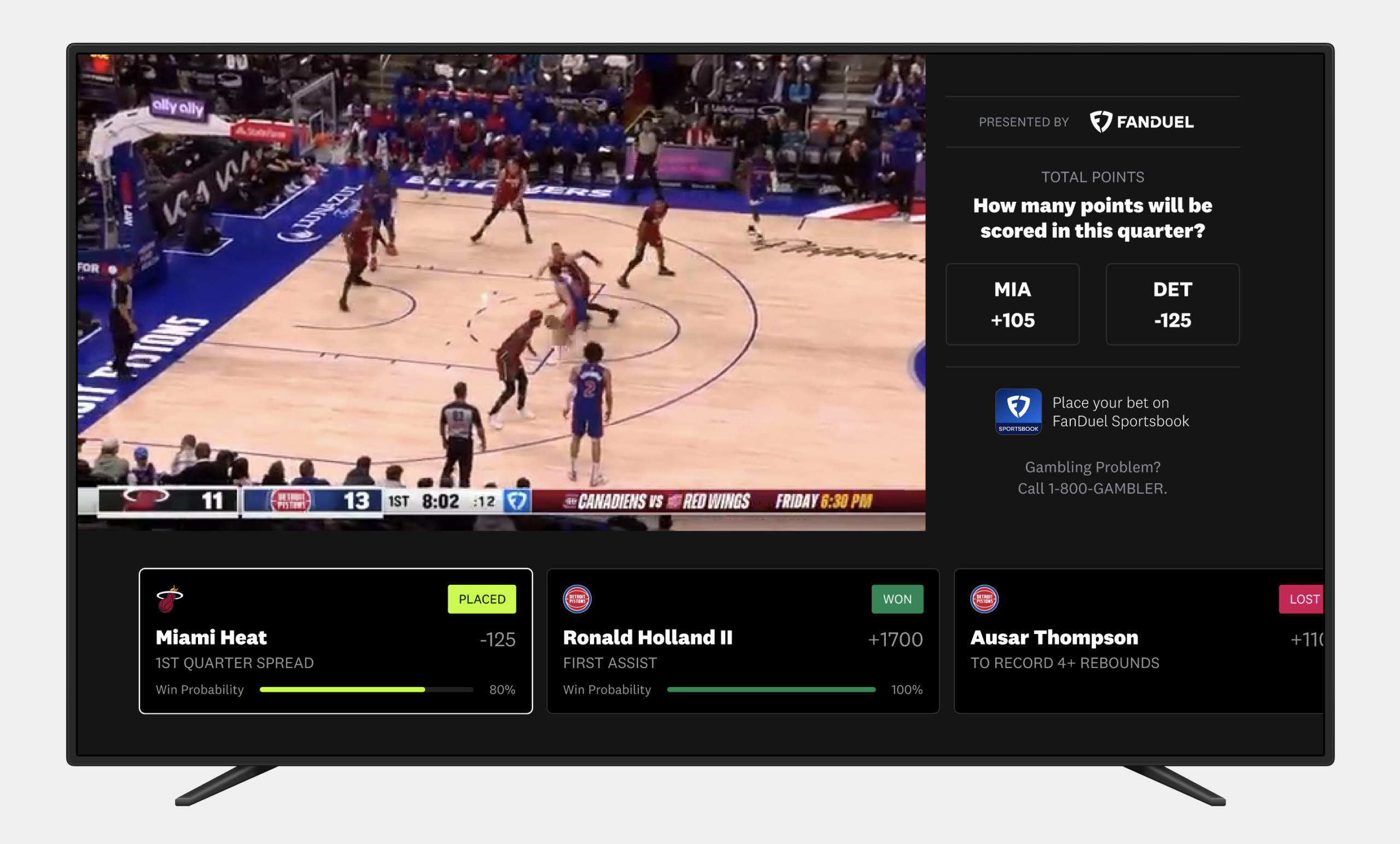
When users in eligible zip codes interact with content, an interstitial page is shown with the single game purchase CTA. On TV, the experience is similar scanning the QR code directs them to the web to purchase that eligible content.

Checkout Experience · Web & App
Since single game purchase isn't tied to a subscription, the checkout pages across all platforms required updates, adding relevant value props and legal copy specific to the one-time purchase experience.

Single Game Credit Managment · Web & App
Built a management section allowing users to see their purchase history and current credits available for redemption.

Redeeming Credits · Web & TV
After purchasing a credit, users can redeem it on an eligible live game or save it to use toward another game at a later time.
02 · PRD to Clarity
17 pages.
Too many assumptions.
Every project starts with a PRD. This one was dense, with 17 pages of requirements that read more like assumptions than decisions. The team spent a full day pulling it apart, flagging contradictions, and turning them into a structured set of questions for product.

"Why have credits at all instead of just saying buy a game for $X?" — If users are buying one game at a time, why build the complexity of an accrual system? That question led to a simpler, more honest framing of the product.
03 · Competitive Audit
How others
handle credits.
Before touching Figma, the team mapped how comparable products handle single-purchase and credit-based flows: Audible, ClassPass, Airbnb, Expedia, Farfetch, and Runway. The goal: find the patterns users already understand and build from there.

04 · Service Blueprint
Who's involved
at every step.
Before wireframes, we built a service blueprint to align on the systems, teams, and user states involved at each stage from anonymous to signed-in. Daily syncs with Engineering kept both sides informed on what was technically executable, and ensured design decisions were grounded in real constraints. For me, this is one of the most critical steps in the design process; getting alignment early prevents costly pivots late.

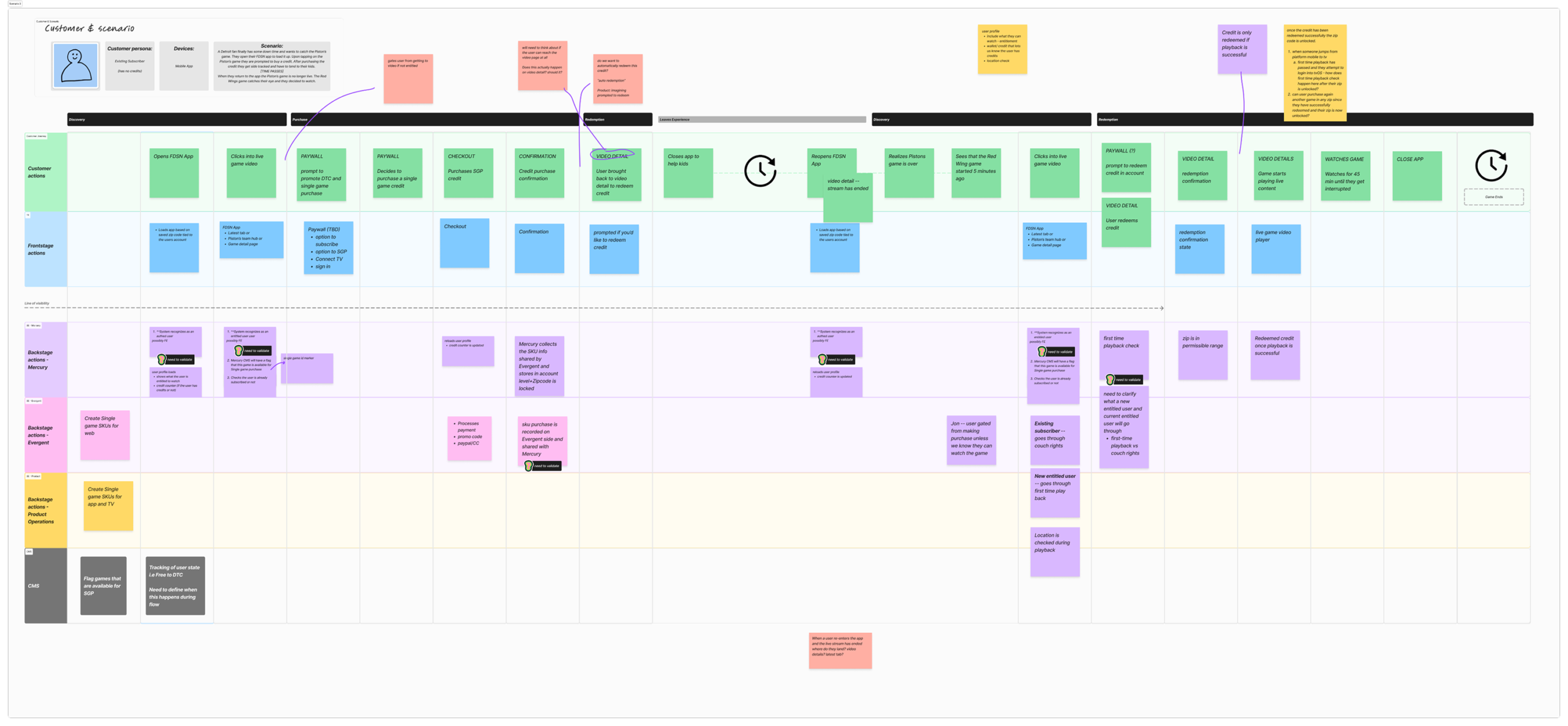
Alignment before pixels!! — Getting everyone on the same page early is the only way to prevent expensive pivots late. Daily syncs with engineering were essential and honestly, direct access to your eng team is one of the most underrated tools a designer can have.
05 · The Flow
Home → Paywall
→ Checkout → Watch.
Seven stages from home screen to the live game. The block model defined the full purchase and redemption path including the key decision point where a user can either watch immediately or save the credit for a different game.

PURCHASE
Buy a single game token
Web or app checkout is $6.99, no subscription. Zip code determines available markets. Token stored in account.
HOLD
Save for the right game
Token sits in the user's account. Redeemable for any eligible live NBA or NHL game in their market, no expiry in phase one.
REDEEM
Watch the game live
One tap to redeem. Works on web, app, and TV with a QR code flow for TV purchases since the platform can't process payments directly.
06 · Designs Delivered
Web. App. TV.
One purchase flow.
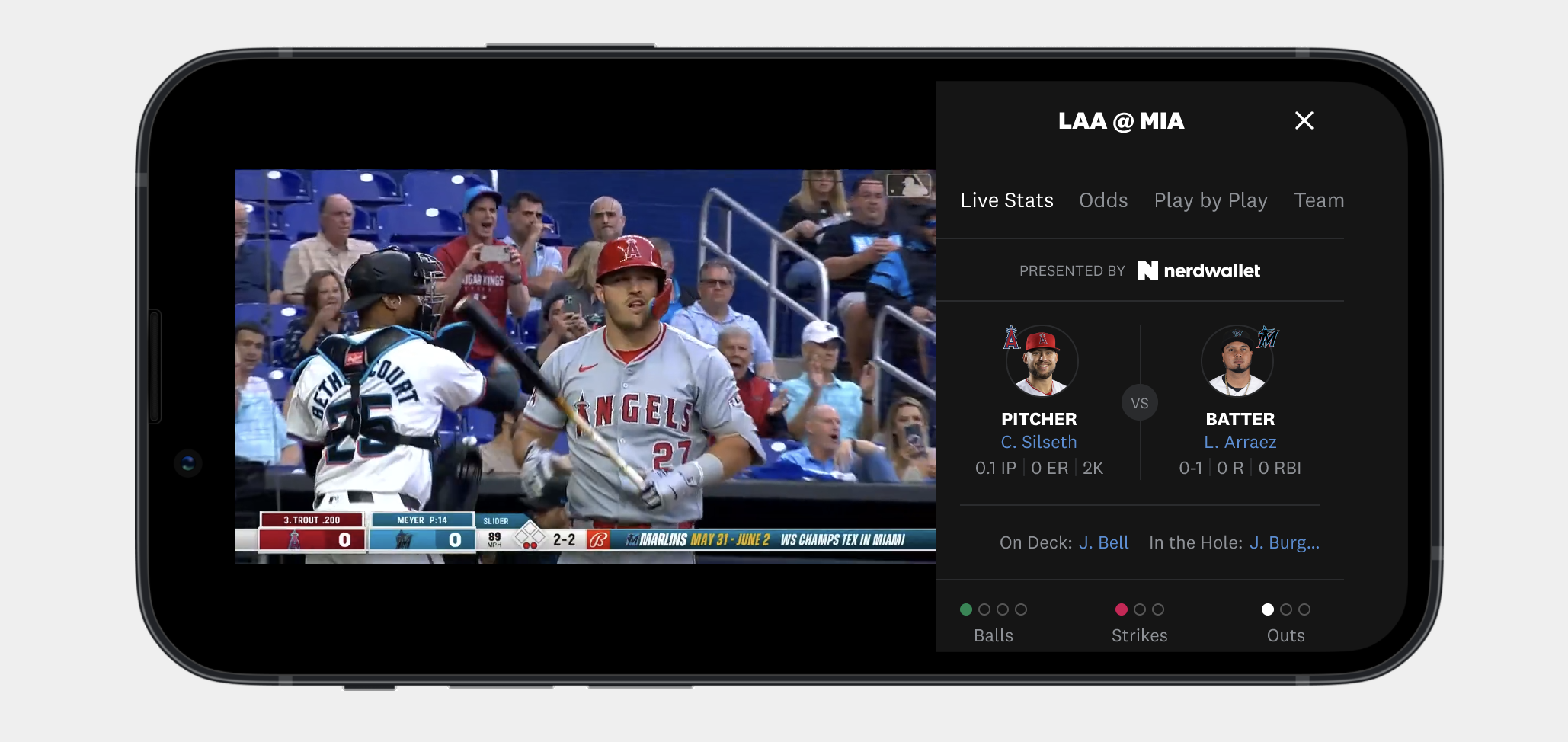
The same flow had to work across three fundamentally different surfaces, each with different input methods, screen sizes, and payment capabilities. TV required a QR code handoff to mobile since in-app purchases weren't available on the platform.
07 · Results
Shipped.
Underperformed.
Here's why.
Single game purchase launched and gave users a genuine non-subscription option. But discoverability was limited by a competing FanDuel marketing offer that was contractually obligated to take priority; the product never got the surface area it needed to convert.
4,105
PURCHASES IN FIRST 2 MONTHS
The feature shipped and users found it, but volume was constrained by discoverability, not product quality.
↓
LOW DISCOVERABILITY
A competing FanDuel offer was contractually prioritized in marketing. Single game purchase was deprioritized in surface placement before it had a chance to perform.
3
PLATFORM SHIPPED
Web · App · TV
A single purchase flow designed to work across fundamentally different surfaces and input models.
0
USER RESEARCH
No research was available to validate design decisions or identify problem areas. Shipped on product instinct and competitive benchmarking alone.
one game.
one token.
shipped on three platforms.
CO LEAD DESIGNER · PRD REVIEW · COMPETITIVE AUDIT · SERVICE BLUEPRINT · WEB, APP + TV FLOWS · HIGH FIDELITY HANDOFFS
Selected Works